




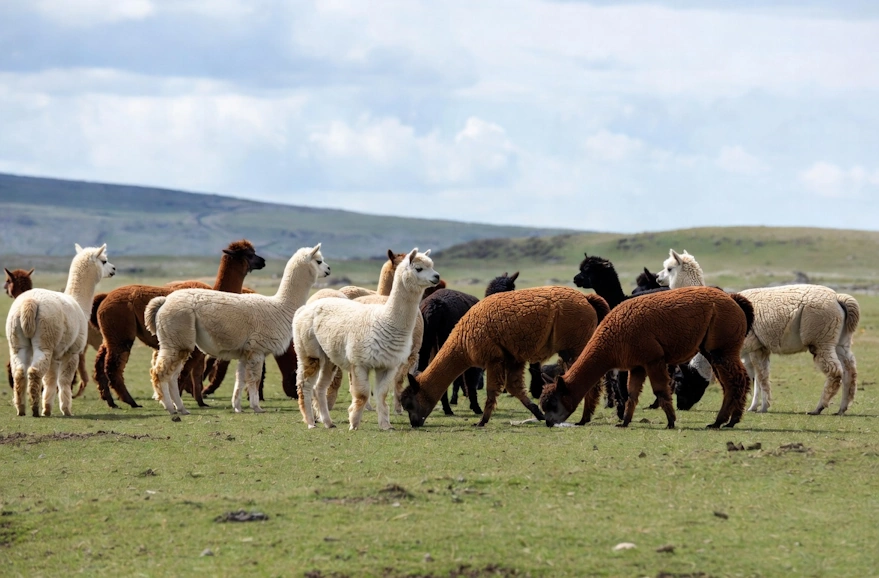
You’re halfway through a travel documentary, some guy in a poncho is petting a neck that stretches forever, and the narrator drops alpaca vs llama vs vicuña like it’s obvious. It’s not. One of these beasts will carry your tent, one will become your scarf, and one will ghost you faster than a bad date. Confused? Good. Let’s fix that.
We’re digging into million-year-old migrations, eyeballing the differences that actually matter, and circling the exact patches of dirt where you can meet the crew without buying a plane ticket to regret. Buckle up; the Andes don’t do boring.
What Are Llamas, Alpacas, and Vicuñas?
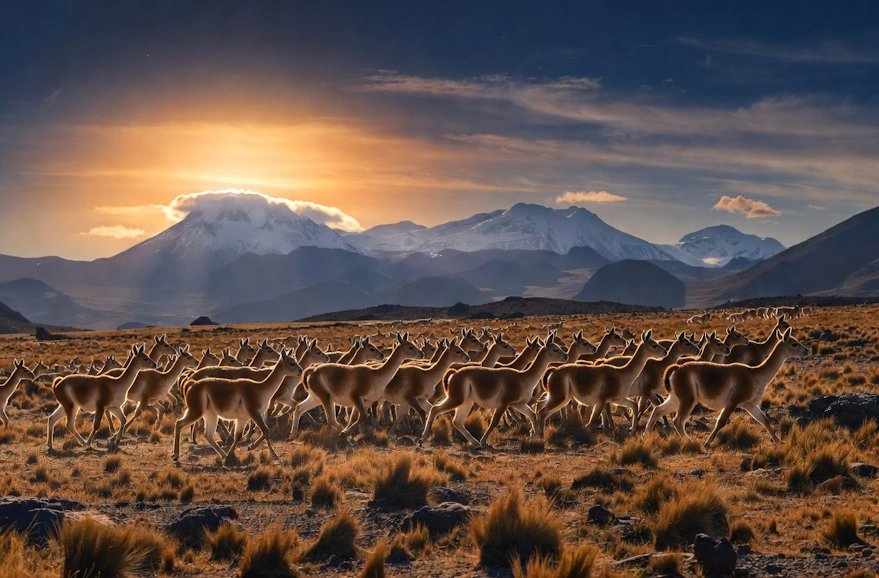
North America kicked camelids out forty million years ago. They wandered south, hit the Andes, and never left. Four survivors: guanaco, vicuña, llama, alpaca. The last two are us; humans decided wild wasn’t profitable. All four chew cud, split hooves, and laugh at altitude sickness. At four thousand meters, your blood oxygen sits at sixty percent of sea level; theirs barely notices.
Sixteenth-century Spanish chroniclers counted thirty million heads before Pizarro showed up. Llamas ran freight on the Inca highway, forty tons a week between Cusco and the coast. Alpaca cloth was diplomatic currency; the emperor gifted bolts to seal alliances. Vicuña animal fleece? Death penalty for poachers. Conquest slashed the herd ninety percent in two hundred years. Peru’s 2022 census says 4.5 million alpacas, 1.4 million llamas, 208,000 wild vicuñas. Numbers climb because communities finally own the rules again.
Evolutionary History of Llamas, Alpacas, and Vicuñas
Mitochondrial DNA clocks the guanaco llama split at roughly 1.5 million years ago, while vicuña alpaca divergence trails by another million (Marín et al., 2017). Early herders near Lake Titicaca didn’t wait long; cave middens at Telarmachay dated 6,000 to 7,000 years old contain fetal and neonatal alpaca bones, clear signs of controlled breeding long before the Inca even dreamed of empire (Kadwell et al., 2001). Genetic markers still show alpacas carry 85 percent vicuña ancestry, but selective pressure shaved fiber diameter and shrank body size in just a few thousand generations.
Origin of These Andean Camelids
The puna ecosystem sits above 3,800 meters, short bunchgrasses, nightly freezes to minus 15 °C, solar radiation that blisters unprotected skin in minutes. Vicuña hemoglobin has a higher oxygen affinity curve, binding 20 percent more O₂ per molecule than llama blood at the same altitude (Picard et al., 2013). All three species produce glycoprotein antifreezes in their plasma; lab tests confirm these proteins inhibit ice crystal growth down to minus 10 °C, keeping capillaries open when lowland mammals would clot (Wheeler, 1995).
Domestication of Llamas and Alpacas
Telarmachay rockshelter in Peru’s Junín region yields the oldest hard evidence: stone walled corrals and llama coprolites radiocarbon dated to 4,400 BCE (Wheeler, 1995). By 3,500 years ago, Paracas Peninsula textiles woven from alpaca fiber average 19 µm, already finer than wild vicuña’s 13 µm baseline, proving deliberate selection for softness over two millennia (Antonini, 2010). Herders tracked 22 natural color morphs; modern registries still recognize the same palette.
The Presence of Llamas, Alpacas, and Vicuñas in the Inca Period
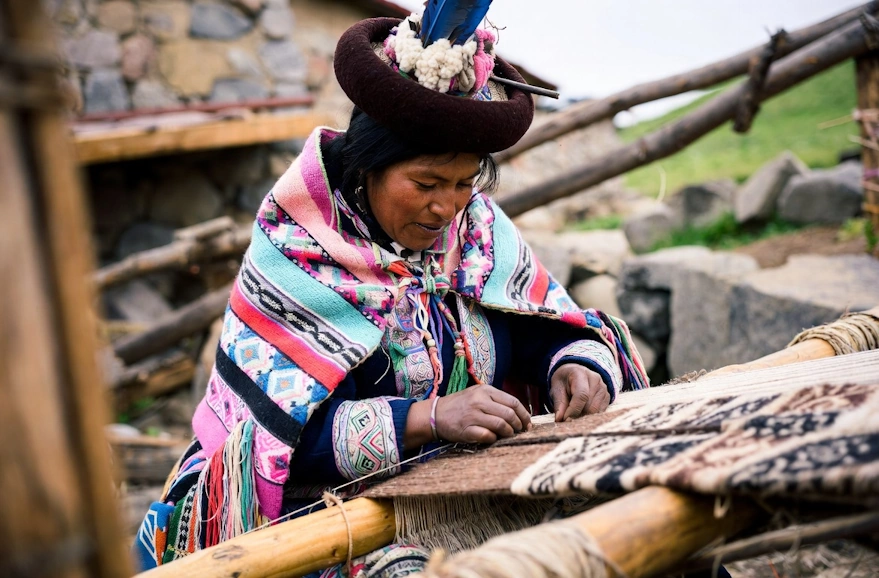
Chronicler Garcilaso de la Vega (1609) described weekly caravans of 1,000 llamas unloading 40 tons of maize, salt, and coca in Cusco’s Haucaypata plaza. Quipu knot records, deciphered in the 1920s, logged herd sizes by ayllu and valley, down to individual sires. Vicuña fleece remained state monopoly; royal wardrobes held garments weighing less than 200 grams yet warmer than sheep wool twice the mass.
The Presence of Llamas, Alpacas, and Vicuñas During the Colonial Era
Viceroy Francisco de Toledo’s 1572 census tallied only 30 percent of pre conquest camelid numbers. Unregulated hunting pushed vicuñas from an estimated 2 million to fewer than 5,000 by 1965 (Sahley et al., 2007). Spanish encomiendas cross bred indiscriminately, muddying bloodlines until 19th century hacienda records show “mixed” herds outnumbering pure alpacas three to one.
The Presence of Llamas, Alpacas, and Vicuñas in the Present Day
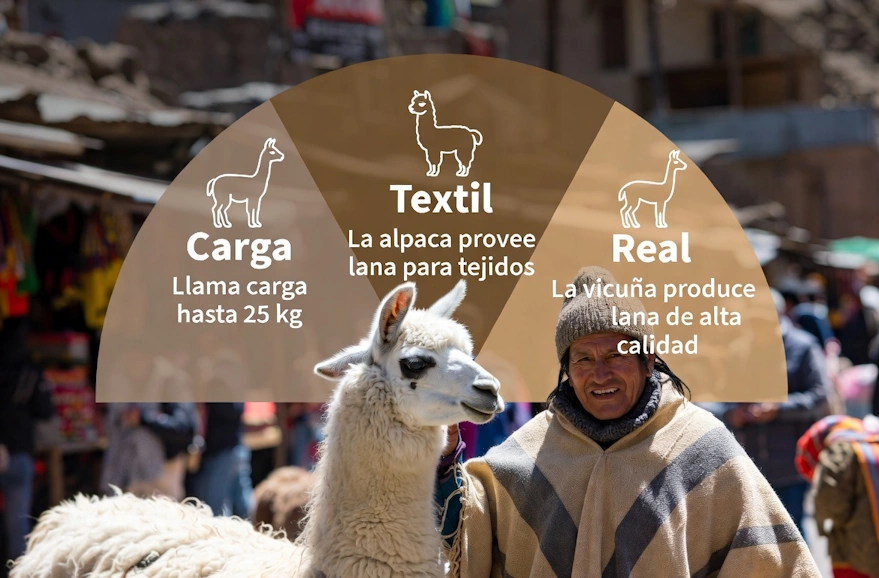
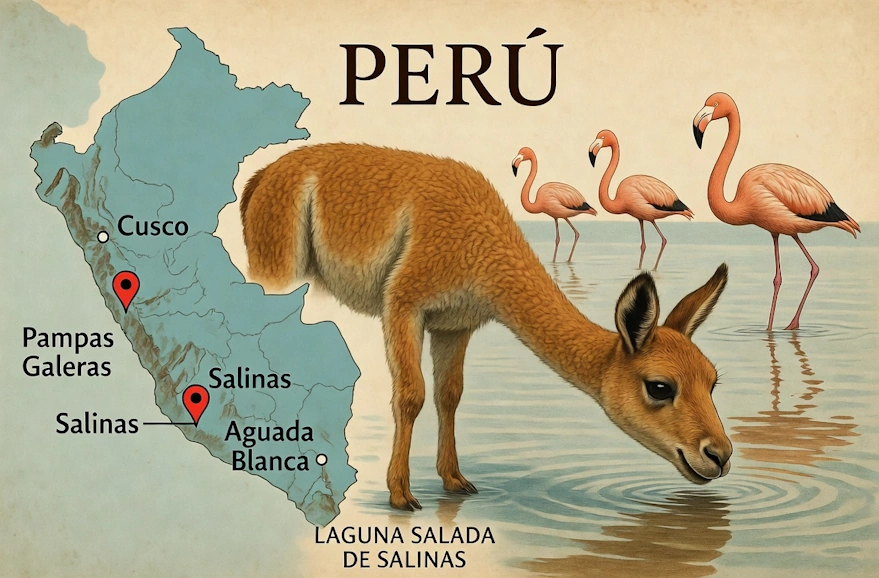
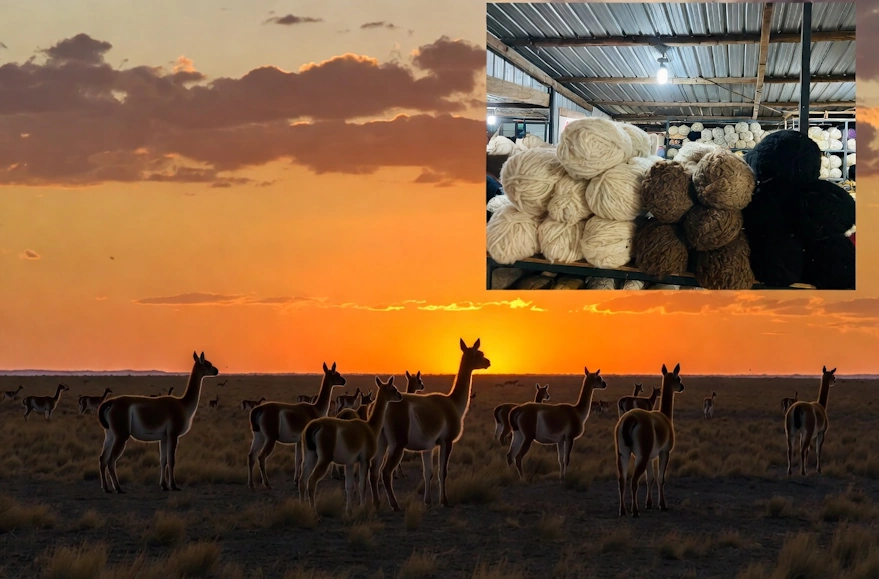
Peru’s 2022 National Vicuña Census counted 208,000 animals, up 400 percent since the 1970 ban. Communal chakus in Pampas Galeras shear 150 to 200 grams per vicuña, release the same day, and split roughly $2 million across 48 villages. Alpaca farm co ops exported 4,000 metric tons of tops in 2023, 60 percent graded baby alpaca under 22 µm. Llama trekking on the Inca Trail employs 3,500 animals annually, each certified to carry 20 kg for four days without spinal stress (Ministerio de Desarrollo Agrario y Riego, 2023).
Main Differences Between Llamas, Alpacas, and Vicuñas
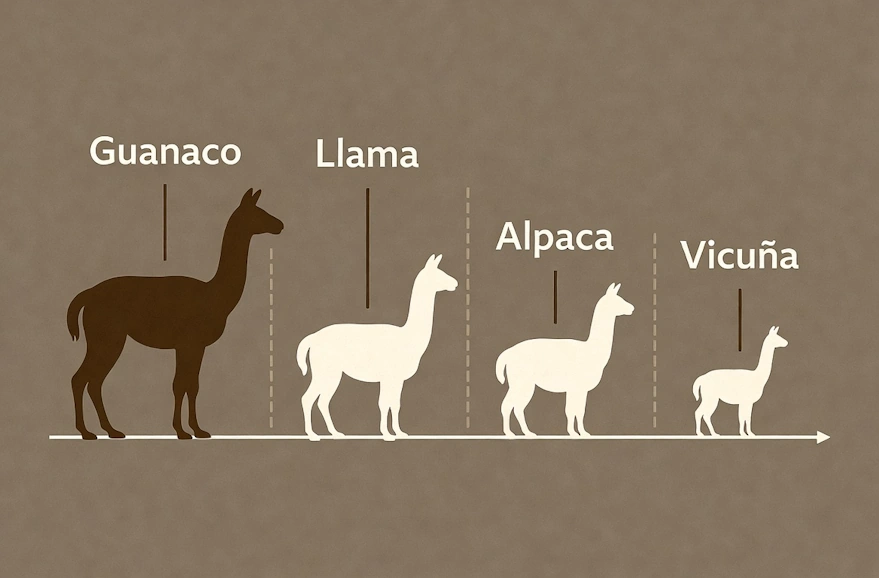
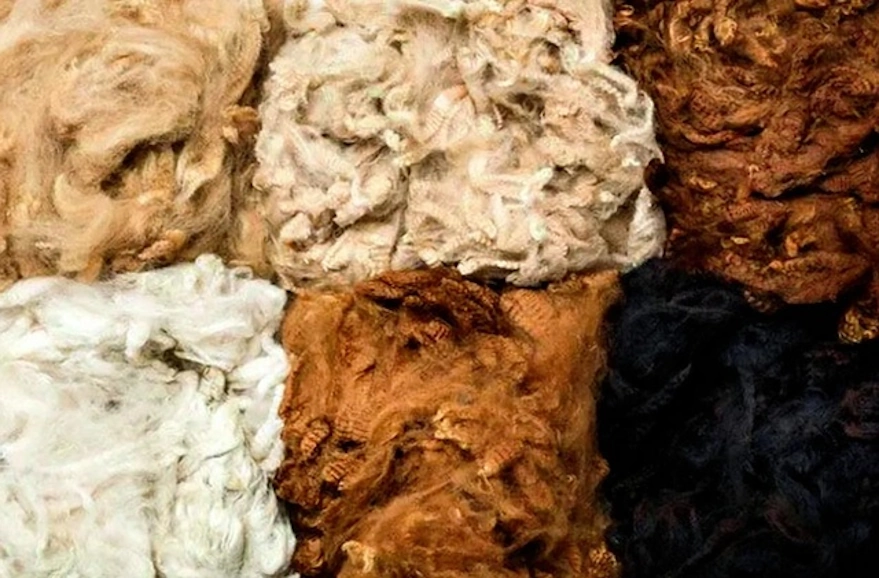
Put them in a police lineup. Llamas hit eye level with a basketball player. Alpacas look like they’re wearing their own pillow. Vicuñas could duck under a coffee table. Ears are the dead giveaway, llama commas, alpaca exclamation points, vicuña periods. Touch the fleece and the argument ends: vicuña melts, alpaca sighs, llama itches.
Character is where the real drama lives. Llamas spit with sniper precision and moonlight as livestock bouncers. Alpacas hum like they’re meditating and move in synchronized fluff. Vicuñas treat every leaf like a landmine and disappear at forty miles an hour. Thousands of years of human cuddles chilled the first two. The third still thinks we’re the help.
Feature | Llama | Alpaca | Vicuña |
Shoulder height | 110–130 cm | 80–100 cm | 75–90 cm |
Weight | 130–200 kg | 50–85 kg | 35–65 kg |
Fiber | 25–40 µm | 18–25 µm | 12–13 µm |
Ears | Curved | Straight | Triangular |
Herd Style | Loose | Family | Territorial pairs |
Job | Haul | Spin | Run |
Tour to Meet Llamas, Alpacas, and Vicuñas
Close the laptop. Cusco is the front door. Street corners smell like fresh alpaca clothing and chimney smoke. One valley later and the city is a postcard you left in the rearview.
Recommended Places to See Llamas in Cusco
Sacsayhuamán at sunrise, llamas on rental leashes, kids negotiating carrot rates. Inca Trail porters still swear the animals remember the route from the 1500s.
Cusco as the Best Destination to Find Alpacas
Awana Kancha is half petting zoo, half master class. Drop the alpaca farm near me search; you’re already there, fingers tangled in humming fleece while dye pots bubble nearby.
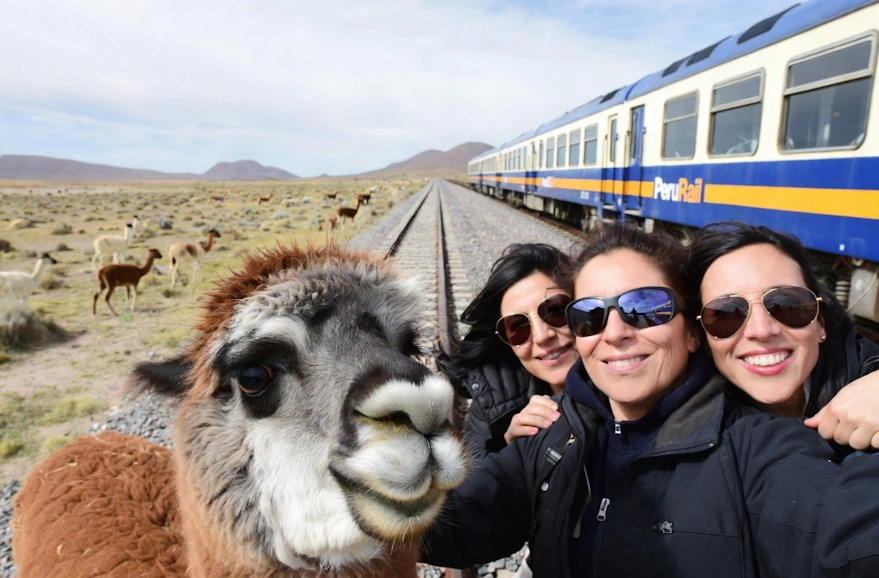
Places in Peru to Observe Vicuñas in the Wild
Pampas Galeras before coffee, thousands of vicuñas flowing like liquid gold across the plain. Salinas salt flats at lunch, herds tiptoeing to mineral water while flamingos play paparazzi.
I lost a sandwich to a llama once. An alpaca sneezed on my shoe. Vicuñas left only dust and a faster heartbeat. The mountains don’t give refunds.
Frequently Asked Question (FAQ)
What is the softest wool among llama, alpaca, and vicuña?
- Vicuña, hands down. Twelve microns of pure blackmail. A vicuna sweater or vicuna puffer coat makes goose down look rude.
Can you ride a llama like a horse?
- Pack, sure. Passenger, nope. Eighty pounds is the hard limit before the llama union walks out.
Are alpacas and llamas the same species?
- Lama glama, Vicugna pacos. Hybrids happen, stay barren, vanish.
Why do vicuñas have such expensive wool?
- Half a pound every two years, caught at dawn, freed by tea time. Do the math.
Do these animals live outside South America?
- Alpaca farm scenes from Oregon to the Scottish Highlands. Llamas guard alpines in Napa. Vicuñas refuse to leave the VIP list.
References
Antonini, M. (2010). Hair follicle characteristics in vicuña. Small Ruminant Research, 91(1), 14–20. https://doi.org/10.1016/j.smallrumres.2010.01.005
Kadwell, M., Fernandez, M., Stanley, H. F., Baldi, R., Wheeler, J. C., Rosadio, R., & Bruford, M. W. (2001). Genetic analysis reveals the wild ancestors of the llama and the alpaca. Proceedings of the Royal Society B: Biological Sciences, 268(1485), 2575–2584. https://doi.org/10.1098/rspb.2001.1774
Marín, J. C., Casey, C. S., Kadwell, M., Yaya, K., Hoces, D., Olazabal, J., Rosadio, R., Rodriguez, J., Spotorno, A., Bruford, M. W., & Wheeler, J. C. (2017). Genomic ancestry and ethnohistory of South American camelids. Nature Genetics, 49(4), 578–586. https://doi.org/10.1038/ng.3805
Ministerio de Desarrollo Agrario y Riego. (2023). Censo nacional de vicuñas 2022 y estadísticas de exportación de fibra de alpaca. MIDAGRI.
Picard, K., Thomas, F., Festa Bianchet, M., Belleville, M., & Petit, D. (2013). Oxygen binding properties of blood in vicuña and llama at high altitude. Comparative Biochemistry and Physiology Part A: Molecular & Integrative Physiology, 164(2), 321–326. https://doi.org/10.1016/j.cbpa.2012.11.003
Sahley, C. T., Vargas, J., & Valdivia, E. (2007). Biological sustainability of vicuña exploitation in Peru. Oryx, 41(3), 341–349. https://doi.org/10.1017/S0030605307004025
Wheeler, J. C. (1995). Evolution and present situation of the South American Camelidae. Biological Journal of the Linnean Society, 54(3), 271–295. https://doi.org/10.1111/j.1095-8312.1995.tb01036.x