

 ES
ES
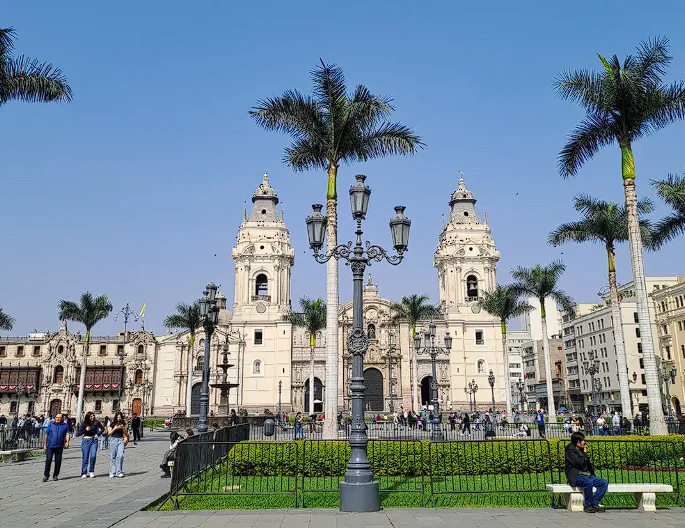
Lima Cathedral, the 400-Year Old Masterpiece at the Heart of Peru's Capital
The Lima Cathedral is a massive Catholic church that has stood on the north side of Plaza de Armas in downtown Lima since 1625. Its full name is the Basilica Cathedral of St. John the Apostle and Evangelist of Lima, and it is the most important religious building in Peru. Over nearly 400 years, it has survived earthquakes, reconstructions, political changes, and centuries of daily use — and today it functions simultaneously as an active place of worship, a museum, and one of the most visited tourist attractions in South America.
Whether you're interested in colonial architecture, Inca and Spanish history, religious art, or just want to see the tomb of the man who conquered the Inca Empire, the Lima Cathedral delivers. This guide covers everything you need to know before visiting, from its construction history to practical details like ticket prices, opening hours, how to get there, and what to see inside.
Table of Contents
- What Is the Lima Cathedral and Why Does It Matter
- Who Built It and When
- What the Lima Cathedral Is Named After
- The History of the Cathedral of Lima
- Pizarro and the First Stone in 1535
- Earthquakes and Rebuildings
- The Cathedral You See Today
- The Architecture of the Lima Cathedral
- The Facade and the Portada del Perdón
- The Twin Towers
- The Interior and Its 15 Chapels
- What to See Inside the Lima Cathedral
- The Tomb of Francisco Pizarro
- The Catacombs Beneath the Cathedral
- The Museum of Religious Art
- The Chapel of Our Lady of Evangelization
- The Historic Choir Books
- Notable People Buried at the Cathedral of Lima
- Lima Cathedral Tickets, Hours and How to Visit
- How Much Does It Cost to Enter
- Opening Hours and the Best Time to Visit
- Where to Buy Tickets Online
- Guided Tours and Audio Guides
- Accessibility for Visitors with Disabilities
- How to Get to the Lima Cathedral
- Public Transport Routes
- From Jorge Chávez Airport to the Cathedral
- Where to Park Nearby
- Where to Stay and Eat Near the Lima Cathedral
- Hotels Within Walking Distance
- Restaurants Near Plaza de Armas
- The Basilica Cathedral of Lima and the Plaza de Armas
What Is the Lima Cathedral and Why Does It Matter
The Lima Cathedral is not just a church. It is the religious, historical, and architectural centerpiece of Peru's capital city. It sits on the same plot of land where Francisco Pizarro founded the city of Lima in 1535, and it has been the seat of the Roman Catholic Archdiocese of Lima for centuries. In 1991, it was designated a UNESCO World Heritage Site as part of the Historic Centre of Lima.
The cathedral matters because it is one of the oldest continuously operating churches in the Americas and one of the finest examples of Spanish colonial architecture on the continent. Its construction spans multiple centuries, its chapels contain the remains of some of the most important figures in Peruvian history, and its museum holds one of the most significant collections of religious art in South America.
Who Built It and When
Francisco Pizarro ordered the construction of the original church in 1535, the same year he founded the city of Lima. Pizarro himself laid the first stone and reportedly carried the first log used in the construction on his own shoulders. The first version of the church was completed in 1538 — a relatively simple structure built primarily of adobe and wood.
That first church did not last long. Over the following decades, it was rebuilt and expanded multiple times as Lima grew from a colonial outpost into one of the wealthiest cities in the Spanish Empire. The major reconstruction that produced the building you see today began in the early 17th century under the direction of architect Francisco Becerra, with later modifications by Juan Martínez de Arrona and other architects.
What the Lima Cathedral Is Named After
The cathedral is officially dedicated to St. John the Apostle and Evangelist, one of the twelve apostles of Jesus and the author traditionally attributed with the Gospel of John, three epistles, and the Book of Revelation. The full Spanish name is Catedral Basílica de San Juan Apóstol y Evangelista de Lima.
The choice of St. John as the patron saint reflects the deep Catholic roots that Pizarro and the Spanish colonizers brought to Peru. The cathedral has carried this name since its founding, and the dedication to St. John remains part of its official title to this day.
The History of the Cathedral of Lima
The history of the Lima Cathedral is a story of ambition, destruction, and persistence. Built, destroyed, rebuilt, damaged by earthquakes, and rebuilt again, the cathedral has been under near-continuous construction and renovation for almost 500 years.
Pizarro and the First Stone in 1535
On January 18, 1535, Francisco Pizarro founded the city of Lima, which he called the "City of the Kings" (Ciudad de los Reyes). As part of the founding, he designated a plot of land on the north side of the main plaza for the construction of a church. This was standard Spanish colonial practice — the church always occupied the most prominent position in the city center.
The first church was modest by any standard. Built of adobe and wood, it had a single nave and a thatched roof. Pizarro inaugurated it in 1540, just five years before his assassination in 1541 by the forces of Diego de Almagro's son. The irony is that the man who built the cathedral was buried elsewhere — his remains would not end up in the cathedral until centuries later.
Earthquakes and Rebuildings
Lima sits in one of the most seismically active regions on Earth, and the cathedral has paid the price repeatedly. Here is the timeline of major destruction and reconstruction:
| Year | Event | Impact on the Cathedral |
|---|---|---|
| 1535 | First stone laid by Pizarro | Original adobe church begun |
| 1538 | First church completed | Simple adobe and wood structure |
| 1540 | Pizarro inaugurates the church | First mass held |
| 1551 | Cathedral status granted | Church elevated to cathedral by Pope Julius III |
| 1564 | Construction of a larger cathedral begins | Replaced original structure |
| 1604 | Second cathedral partly completed | Larger but still incomplete |
| 1622 | Third cathedral celebrates first mass | Main structure completed |
| 1625 | Cathedral officially consecrated | The building largely as it stands today |
| 1687 | Major earthquake | Vaults destroyed, 10 years of reconstruction |
| 1746 | Devastating earthquake (8.0+ magnitude) | Many vaults and pillars collapsed, 12 years of reconstruction |
| Late 1700s | Two towers added | Cathedral reaches its current height |
| 1893 | Cathedral closes for repairs | Years of neglect had taken a toll |
| 1896–1898 | Major renovation completed | Cathedral reopens to the public |
| 1940s–present | Ongoing restoration | Periodic repairs and conservation work |
The 1746 earthquake was the most destructive. It struck on October 28, 1746, and devastated much of Lima. The cathedral suffered massive structural damage, and the reconstruction took over a decade. Much of the interior decoration visible today — the ornate altarpieces, gilded chapels, and carved wooden ceilings — dates from this post-1746 reconstruction period.
The Cathedral You See Today
The building that stands on Plaza de Armas today is the product of nearly five centuries of construction, destruction, and reconstruction. The basic structure dates from the early 17th century, but significant portions were rebuilt after the 1746 earthquake, and the twin towers were added in the late 18th century.
The cathedral has been in continuous use since 1625, making it one of the oldest functioning churches in the Americas. It was declared part of the Historic Centre of Lima UNESCO World Heritage Site in 1991 and has been the subject of ongoing conservation and restoration work by the Peruvian government and international organizations.
Today, the cathedral occupies an entire city block on the north side of Plaza de Armas, with its main entrance facing south across the plaza. The building measures approximately 100 meters long and 30 meters wide, making it one of the largest colonial-era churches in South America.
The Architecture of the Lima Cathedral
The Lima Cathedral is a masterwork of Spanish colonial architecture, blending Renaissance, Baroque, and Neoclassical elements that reflect the different periods in which it was built and rebuilt. The exterior is imposing but relatively restrained. The interior is where the architectural drama really unfolds.
The Facade and the Portada del Perdón
The main entrance to the cathedral is through the Portada del Perdón (Door of Forgiveness), a grand stone gateway that faces Plaza de Armas. The name comes from the Catholic tradition of plenary indulgences — complete forgiveness of sins — granted to those who enter through this door under certain conditions.
The facade is built in a Renaissance-Baroque style with two main levels. The lower level features fluted columns, arched niches with statues of saints, and carved stone decoration typical of 17th-century Spanish colonial architecture. The upper level was added later and reflects a more Neoclassical influence, with simpler lines and a large central window.
Above the Portada del Perdón, a carved stone coat of arms represents the city of Lima, flanked by the coats of arms of the archdiocese and the Spanish crown. The overall effect is one of grandeur and authority — this was not just a church but a statement of Spanish colonial power.
The Twin Towers
The cathedral's two bell towers are among the most recognizable features of Lima's skyline. They were added in the late 18th century, rising to about 45 meters (148 feet) above street level. The towers are Baroque in style, with multiple tiers of bells, ornamental balustrades, and pointed cupolas.
Before the 1746 earthquake, the cathedral had shorter, less impressive towers. The current towers were part of the post-earthquake reconstruction and were designed to be taller and more visually dominant — a deliberate statement that the cathedral, and the colonial power it represented, could not be brought down permanently by nature.
From the Plaza de Armas, the towers frame the cathedral's facade symmetrically and are particularly impressive at sunset, when the warm light hits the pale stone and the bells catch the last of the sun.
The Interior and Its 15 Chapels
The interior of the Lima Cathedral is organized around a central nave with two side aisles, separated by rows of carved stone pillars and arches. The ceiling features ribbed vaulting typical of Gothic-influenced Spanish colonial churches, and the floor is a striking pattern of black and white tiles.
But the real architectural treasures are the 15 chapels that line both sides of the cathedral. Each chapel is dedicated to a different saint or religious figure, and each has its own distinct character — some are lavishly decorated with gold leaf, carved wood, and oil paintings, while others are more restrained and contemplative.
The 15 chapels, in order from the main entrance moving clockwise, are:
| # | Chapel Name | Notable Features |
|---|---|---|
| 1 | Tomb of Francisco Pizarro | Contains the remains of the conquistador, ornate marble markers |
| 2 | Saint John the Baptist | Patron saint's chapel, traditional Andean religious art |
| 3 | Our Lady of Candlemas | Statue of the Virgin, elaborate gilded altarpiece |
| 4 | Saint Toribio de Mogrovejo | Dedicated to the second Archbishop of Lima, now a saint |
| 5 | Saint Anne | Mother of the Virgin Mary, carved wooden retablo |
| 6 | Chapel of the Visitation | Depicts the visit of Mary to Elizabeth |
| 7 | Chapel of the Souls | Dedicated to the souls in purgatory, dramatic paintings |
| 8 | Chapel of the Sacred Heart | Devotion to the Sacred Heart of Jesus |
| 9 | Saint Apolonia | Patron saint of dentists, small intimate space |
| 10 | Our Lady of Peace | Peace-themed devotional space |
| 11 | Our Lady of Evangelization | Most ornate chapel, massive gilded altarpiece |
| 12 | Saint Rose of Lima | Dedicated to Peru's first saint, born in Lima in 1586 |
| 13 | Our Lady of La Antigua | One of the oldest devotions in the cathedral |
| 14 | Saint Joseph | Notable for its "naked" wood — minimal decoration, natural wood grain |
| 15 | Choir and Main Altar | The liturgical heart of the cathedral |
The contrast between the chapels is striking. The Chapel of Our Lady of Evangelization is a riot of gold leaf, carved angels, and baroque extravagance. The Chapel of Saint Joseph, by contrast, features bare, unadorned wood — a deliberate choice that highlights the natural beauty of the timber and connects to St. Joseph's identity as a carpenter.
What to See Inside the Lima Cathedral
Most visitors spend between 60 and 90 minutes inside the cathedral. There is a lot to see, and it's worth taking your time. Here are the highlights.
The Tomb of Francisco Pizarro
The tomb of Francisco Pizarro, the Spanish conquistador who conquered the Inca Empire and founded Lima, is in the first chapel on the right side of the cathedral as you enter. It is the single most visited feature of the cathedral and the reason many tourists come here in the first place.
Pizarro was assassinated in 1541 in the Government Palace across the plaza from the cathedral. His remains were moved several times over the centuries and were lost for a period in the 19th century before being rediscovered in 1891 during renovations. They were placed in their current location in a glass case in 1985.
The tomb itself is an elaborate marble and bronze monument, but the most interesting detail is the small crypt beneath the marble floor, where Pizarro's actual remains are kept in a lead box. A separate glass display case nearby contains the mummified head and bones attributed to Pizarro. The identification has been debated by historians, but the consensus is that these are indeed the remains of the conquistador.
The Catacombs Beneath the Cathedral
Beneath the cathedral lies a network of catacombs that served as the primary burial site for Lima's elite during the colonial period, until the city's main cemetery was established in 1808. The catacombs contain the remains of an estimated 70,000 to 80,000 people.
The catacombs are not as extensive as those beneath the nearby Church of San Francisco, but they are included in the cathedral's ticket and are worth visiting. Open graves show how bodies were stacked in communal burial pits — in some cases, you can see the skeletal remains of multiple individuals in a single space.
The catacombs are accessed through a staircase near the back of the cathedral. The space is cool, dimly lit, and atmospheric — a stark contrast to the ornate chapels above. Some visitors find it eerie, others fascinating. Either way, it provides a direct physical connection to Lima's colonial past that you won't get anywhere else in the city.
The Museum of Religious Art
The cathedral's museum occupies several rooms and contains a collection of colonial-era religious art that is among the most important in South America. The collection includes oil paintings, sculptures, vestments, gold and silver liturgical objects, and several items connected to papal visits.
Highlights include:
- 18th-century nativity chest — an ordinary-looking wooden box that opens to reveal an extraordinarily detailed nativity scene carved in miniature. The level of craftsmanship is remarkable.
- 18th-century statue of Saint Joseph holding the baby Jesus — a carved wooden figure with expressions so lifelike and tender that it stands out even among the museum's extensive collection.
- Historic choir books — massive volumes measuring about two feet high, containing medieval and Renaissance-era musical notation. They are displayed behind glass in a small room on the upper floor.
- Papal memorabilia — items connected to the visits of Pope John Paul II, who came to Lima in 1985 and 1988, including vestments and liturgical objects used during the papal masses.
- Colonial paintings — dozens of oil paintings from the Cusco School (Escuela Cuzqueña) and Lima School of painting, depicting religious scenes in the distinctive blend of European and Andean artistic traditions.
- Historic vestments — church garments dating back several centuries, including embroidered chasubles, mitres, and ceremonial robes.
The Chapel of Our Lady of Evangelization
This is the most visually overwhelming space in the entire cathedral. The chapel is dominated by an enormous gilded altarpiece (retablo) that covers the entire wall behind the altar, rising from floor to ceiling with carved angels, saints, floral motifs, and religious scenes covered in gold leaf.
The sheer density of decoration is staggering. Every square inch of the altarpiece is carved, gilded, or painted. It is Baroque art at its most excessive — a deliberate attempt to create a visual experience so overwhelming that it inspires awe and devotion. Photography barely captures the scale and detail of the piece. You need to stand in front of it and look up to appreciate what you're seeing.
The Historic Choir Books
In a small room on the upper floor of the cathedral, accessible by a staircase near the museum, is a collection of choir books that date back several centuries. These are enormous hand-lettered and illustrated volumes, each measuring roughly 60 centimeters (two feet) tall and 30–45 centimeters wide.
The books contain musical notation for liturgical chants and hymns used during cathedral services. The script is medieval in style, and several pages feature elaborate illuminated initials and decorative borders. A blown-up photograph of one of the pages is displayed alongside the books so visitors can see the detail of the calligraphy and illustration up close.
Unfortunately, the books are kept behind glass and cannot be opened or browsed. But even through the glass, the size and craftsmanship of these volumes is impressive — a reminder that the cathedral was not just a building but a center of artistic and intellectual production during the colonial period.
Notable People Buried at the Cathedral of Lima
The Lima Cathedral is the final resting place of several of the most important figures in Peruvian history. While Pizarro is the most famous, he is not the only notable person buried here.
| Person | Dates | Significance |
|---|---|---|
| Francisco Pizarro | c. 1478–1541 | Conquistador who conquered the Inca Empire and founded Lima |
| Sebastián de Belalcázar | c. 1490s–1551 | Spanish conquistador who founded Quito and other cities |
| Juan de Betanzos | 1510–1576 | Spanish chronicler who wrote one of the most important accounts of Inca history |
| Pedro de la Gasca | 1493–1567 | Spanish priest and diplomat who ended the rebellion of Gonzalo Pizarro |
| Several Archbishops of Lima | Various | Multiple archbishops over four centuries are interred in the cathedral's crypts and chapels |
The remains of these historical figures are located in different parts of the cathedral — some in the main chapels, others in the crypts beneath the floor. The most visited is, of course, Pizarro's tomb, which draws thousands of visitors every month.
Lima Cathedral Tickets, Hours and How to Visit
Visiting the Lima Cathedral is straightforward, but there are a few practical details worth knowing before you go.
How Much Does It Cost to Enter
| Ticket Type | Price (Soles) | Price (USD) | Includes |
|---|---|---|---|
| General admission (adult) | S/ 10 | $2.70 | Cathedral + Museum + Catacombs + Archbishop's Palace |
| Students (with ID) | S/ 5 | $1.30 | Same as general admission |
| Children under 10 | Free | Free | Same areas |
| Guided tour (Spanish) | S/ 20 – 30 | $5.30 – $8 | Admission + guided tour with cathedral guide |
| Guided tour (English) | S/ 30 – 50 | $8 – $13.30 | Admission + English-speaking guide |
| Audio guide rental | S/ 10 – 15 | $2.70 – $4 | Self-guided audio tour in multiple languages |
The admission price is one of the best values in Lima. For less than $3 USD, you get access to the cathedral, the museum, the catacombs, and the Archbishop's Palace next door. The Archbishop's Palace is worth visiting on its own — it contains colonial-era rooms, religious art, and a courtyard with historical significance.
Opening Hours and the Best Time to Visit
| Day | Hours |
|---|---|
| Monday through Friday | 9:00 AM – 5:00 PM |
| Saturday | 10:00 AM – 1:00 PM |
| Sunday | Closed for regular services (mass only) |
| Public holidays | Hours may vary — check locally |
The best time to visit is weekday mornings between 9:00 and 11:00 AM. This is when the cathedral is least crowded, the light filtering through the windows is at its best, and you can take photos without too many people in the frame. By midday, tour groups start arriving, and the space gets noticeably busier.
Saturdays have limited hours (closing at 1:00 PM), and the cathedral is closed to tourists on Sundays because it is used for regular mass services. If you want to attend mass, services are held throughout the morning on Sundays and are open to the public.
Avoid visiting during major Catholic holidays (Easter week, Christmas, Corpus Christi) unless you want to experience the cathedral during a religious celebration — in which case it's extraordinary, but you won't be able to move freely or take a leisurely tour.
Where to Buy Tickets Online
Tickets can be purchased in person at the cathedral entrance. As of 2026, there is no official online ticketing system run by the cathedral itself. However, several tour platforms sell combined tickets that include the cathedral along with other Lima attractions.
If you prefer to buy a guided tour in advance, platforms like GetYourGuide, Viator, and Civitatis offer Lima Cathedral tours that include skip-the-line access and a bilingual guide. These typically cost between $15 and $30 USD per person and are worth it if you want context and explanation that you won't get walking through on your own.
For walk-up ticket purchases, the line is usually short (5–10 minutes on weekdays). Cash in soles is preferred, though some ticket windows accept cards.
Guided Tours and Audio Guides
A guided tour significantly enhances the visit because the cathedral's history, architecture, and art are dense enough that most visitors will miss important details without someone pointing them out.
Cathedral guides are available at the entrance and offer tours in Spanish for around S/ 20–30 ($5.30–$8 USD) per person. English-speaking guides are available but more expensive, typically S/ 30–50 ($8–$13.30 USD). Tours last about 45 minutes to 1 hour.
Audio guides are available for rent at the entrance for around S/ 10–15 ($2.70–$4 USD). They cover the main highlights but lack the depth and flexibility of a live guide.
External tour companies offer walking tours of colonial Lima that include the cathedral as a stop. These are a good option if you want to see the cathedral as part of a broader exploration of the historic center. Expect to pay $20–$40 USD for a 3–4 hour walking tour that covers the cathedral, Plaza de Armas, the Archbishop's Palace, and other nearby colonial sites.
Accessibility for Visitors with Disabilities
The cathedral has limited accessibility for wheelchair users. The main floor of the cathedral is largely flat and navigable, but the catacombs are accessed via a narrow staircase and are not accessible. The museum rooms on the upper floor are also reached by stairs only.
Visitors with mobility issues can still enjoy the main nave, the 15 ground-floor chapels, and Pizarro's tomb without difficulty. The staff at the entrance are generally helpful and can provide guidance on which areas are accessible.
How to Get to the Lima Cathedral
The cathedral is on the north side of Plaza de Armas in the Historic Centre of Lima, about 12 kilometers from Jorge Chávez International Airport.
Public Transport Routes
Lima's historic center is served by the Metropolitano bus system, which runs along the Avenida Tacna and Paseo de la República corridor. The closest Metropolitano station to the cathedral is Estación Central, about a 10-minute walk from Plaza de Armas.
Several city bus routes also pass through or near Plaza de Armas, though Lima's bus system can be confusing for first-time visitors. The Metropolitano is the most reliable and easiest option for tourists.
The Lima Metro (Línea 1) does not directly serve the historic center, but it connects to the Metropolitano at certain transfer points. For most visitors, a taxi or ride-hailing app is the simplest way to reach the cathedral.
From Jorge Chávez Airport to the Cathedral
| Transport Option | Time | Cost (Soles) | Cost (USD) |
|---|---|---|---|
| Taxi from airport (official) | 45–70 min | S/ 50 – 80 | $13.30 – $21.30 |
| Taxi from airport (street) | 45–70 min | S/ 35 – 60 | $9.30 – $16 |
| InDrive/Uber from airport | 45–70 min | S/ 30 – 55 | $8 – $14.70 |
| Airport Express Lima (bus) | 60–90 min | S/ 15 – 25 | $4 – $6.70 |
The taxi is the most convenient option. The official airport taxis (bookable at counters inside the terminal) are more expensive but reliable. InDrive and Uber are cheaper but may take a few minutes longer for a driver to arrive. Traffic in Lima can be severe during rush hours (7–9 AM and 5–8 PM), so plan accordingly.
Where to Park Nearby
Driving in Lima's historic center is not recommended for visitors — the streets are narrow, confusing, and congested. If you do drive, the closest parking options are:
- Estacionamiento Real Plaza Centro Cívico — a large parking garage about a 10-minute walk from Plaza de Armas, with reasonable hourly rates.
- Street parking — available on some surrounding streets but unreliable and not recommended for tourists unfamiliar with the area.
- Hotel parking — if you're staying at a hotel in the historic center, use their parking and walk to the cathedral.
Where to Stay and Eat Near the Lima Cathedral
The historic center of Lima has undergone a significant revival in recent years, with new hotels and restaurants opening within walking distance of Plaza de Armas.
Hotels Within Walking Distance
| Hotel | Distance to Cathedral | Category | Price Range (per night) |
|---|---|---|---|
| Hotel Bolívar | 1 minute (on the plaza) | Historic mid-range | $60 – $120 USD |
| Palacio del Inka (Luxury Collection) | 3 minutes | Luxury | $180 – $350 USD |
| Casa Andina Standard Centro | 5 minutes | Mid-range | $50 – $90 USD |
| Ibis Lima Centro | 8 minutes | Budget | $35 – $55 USD |
| Hotel Maury | 2 minutes | Historic mid-range | $55 – $100 USD |
| Gran Hotel Bolívar | 1 minute | Historic landmark | $70 – $130 USD |
| Doubletree by Hilton El Pardo | 10 minutes | Mid-range | $70 – $120 USD |
Restaurants Near Plaza de Armas
| Restaurant | Distance | Cuisine | Price Range |
|---|---|---|---|
| La Rosa Náutica Centro | 2 minutes | Peruvian criollo | S/ 30 – 60 per person ($8 – $16) |
| Café Haiti | 1 minute (on the plaza) | Coffee and light meals | S/ 10 – 25 ($2.70 – $6.70) |
| Restaurante Popular Cordano | 2 minutes | Traditional Peruvian, historic bar | S/ 20 – 45 ($5.30 – $12) |
| Astrid y Gastón | 15 minutes (walking) | Peruvian fine dining | S/ 100 – 200 ($27 – $53) |
| Cevichería La Mar Centro | 10 minutes | Seafood, ceviche | S/ 35 – 70 ($9.30 – $18.70) |
| El Cordano | 2 minutes | Classic Lima tavern, since 1905 | S/ 15 – 35 ($4 – $9.30) |
| San Antonio | 3 minutes | Bakery and café | S/ 8 – 20 ($2.10 – $5.30) |
For a quick, cheap, and authentically Lima meal, Café Haiti and El Cordano are institutions that have been serving locals and visitors for over a century. For a fine dining experience, Astrid y Gastón (located in a colonial mansion nearby) is consistently rated as one of the best restaurants in Latin America.
The Basilica Cathedral of Lima and the Plaza de Armas
The cathedral and the Plaza de Armas are inseparable. The plaza is the geographic, historical, and symbolic center of Lima — the exact spot where Pizarro founded the city in 1535. Every major event in Lima's history, from colonial celebrations to independence declarations to political protests, has taken place on or around this plaza.
The cathedral occupies the entire north side of the plaza, making it the largest and most prominent building in the square. The other sides are occupied by the Government Palace (Palacio de Gobierno, the official residence of Peru's president), the Archbishop's Palace (with its famous wooden balconies), the Municipal Palace (city hall), and commercial buildings with restaurants and shops.
The plaza itself is a large, open public space with gardens, fountains, and a central bronze fountain dating from 1651. It is a popular gathering place for locals and tourists alike, and it's the starting point for most walking tours of colonial Lima.
Walking out of the cathedral and standing in the plaza, you can see the Government Palace directly across from you, the Archbishop's Palace to your right with its ornate wooden balconies, and the bustling commercial streets of Jiron de la Union and others radiating outward. It is, without exaggeration, the most historically significant intersection in Peru.